
●  THE OWNER STILL ANSWERS THE PHONE LICENSED · BONDED · INSURED  /  PLUMB · LEVEL · SQUARE
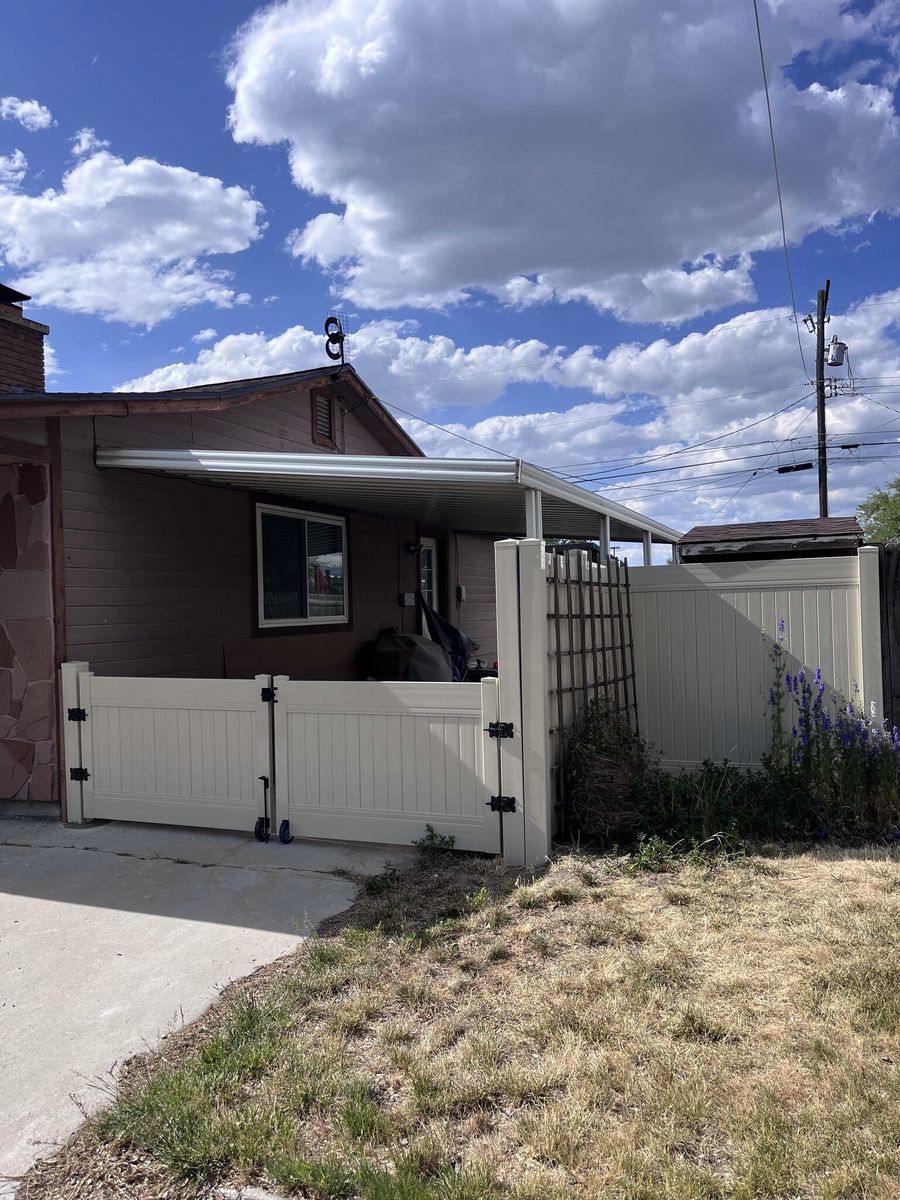
Vinyl Fence Installation in Salt Lake City, UT: white tongue-and-groove vinyl privacy fence installed by Trusted Fence Company

Vinyl Fence Installation in Salt Lake City, UT

On the day we promise. Priced in writing.

Vinyl fence installation in Salt Lake City for homes that want privacy without paint, stain, or rot. The owner walks your yard and writes the quote himself.

★FIVE-STAR RATED$0TRIP FEE●SAME-DAY RESPONSE✓SATISFACTION GUARANTEED

Vinyl fence installation takes our crew about three days on an average backyard. You get solid panels, clean lines, and upkeep that comes down to a garden hose.

If a contractor has ever gone quiet on you mid-project, you will like how we work. The owner, Landon Mickelson, writes every quote. The crew that builds it shows up on the promised day, and the price is in writing before anything starts.

Is a Vinyl Fence Right for Your Yard?

Short answer: Vinyl fits if you want solid privacy you never paint, stain, or seal. If you want real wood grain or the lowest price today, another fence may serve you better, and we will tell you that at the estimate.

Vinyl fits when you want two things at once: a yard nobody can see into, and a fence that is not on your chore list. Wood can give you privacy too, but it needs staining or sealing to keep from graying and cracking. Vinyl asks for a garden hose.

Vinyl is also sold as PVC or plastic fencing. PVC fence installation and plastic fence installation are the same job.

Who We Build Vinyl Fences For

  • Busy households that want privacy around the patio or hot tub without adding a fence to the chore list
  • Families with kids or dogs, since smooth panels have no splinters and solid tongue-and-groove leaves no gap for a dog to test
  • Close-set neighbors. A Cottonwood Heights family spent two summers trying to screen their yard with shrubs, and half of them browned out by August. Landon walked the yard with them, and a six-foot vinyl fence fixed it in a few days
  • Homes with HOA rules that spell out height, color, and panel style
  • Owners who plan to stay and would rather pay more up front than keep paying for stain and labor

Signs It's Time for a New Fence

The clearest sign is a wood fence you're tired of feeding. If you've repainted twice and it still looks rough, the fence is telling you something. Warped boards, popped nails, and a gate that needs a shoulder to close all say the same thing.

Already have vinyl? Chalky, faded panels usually mean cheap material with no UV protection. Panels that rattle or lift in wind were never seated right, and posts that wobble inside their sleeves are a problem a new panel won't fix. One cracked panel on solid posts does not mean the whole fence is done. Fading, brittleness, or loose posts across the whole line do.

When we would point you somewhere else

If you love the warmth of real wood and don't mind caring for it, our wood fence installation and fence staining and sealing are the better match. If budget is tight right now, vinyl usually costs more to buy and install than a basic wood fence, even though it costs less to keep up. And if you just need to keep a dog in or mark a line without blocking the view, chain link or aluminum is built for that. Still unsure? That is what the free estimate is for. Landon walks your yard, checks the slope and your HOA rules with you, and gives you a straight answer on whether vinyl is the right fit.

Our Vinyl Fence Installation Options

Most of our vinyl work is full-height tongue-and-groove privacy fence, no gaps, no visible fasteners, in white, tan, or grey, with specialty colors available. It's the workhorse for privacy fences between close-set homes. We use Homeland vinyl, made with ACCU-Shield UV color protection, because cheap vinyl doesn't survive this altitude. Vinyl quality isn't only color or panel thickness: the ASTM F964 PVC fencing standard covers extrusion quality, dimensional stability, and weatherability, which is why the product line matters as much as the word vinyl.

Privacy is the main job. We can build any style of vinyl fence:

  • Full-height privacy
  • Semi-private, with some light between the slats
  • Vinyl picket fence installation for front yards, where you want the look without the wall

Vinyl fence gates are part of the same job. We build walk gates and drive gates in the same panels as the rest of your line.

  • The quantity and size of every gate is written into your quote
  • Gate posts get an inner steel sleeve
  • Every gate has a welded steel frame hidden inside the vinyl

Not sure which style fits? Bring us your HOA's fence sheet or a photo of a fence you like. We will match it panel for panel in the quote.

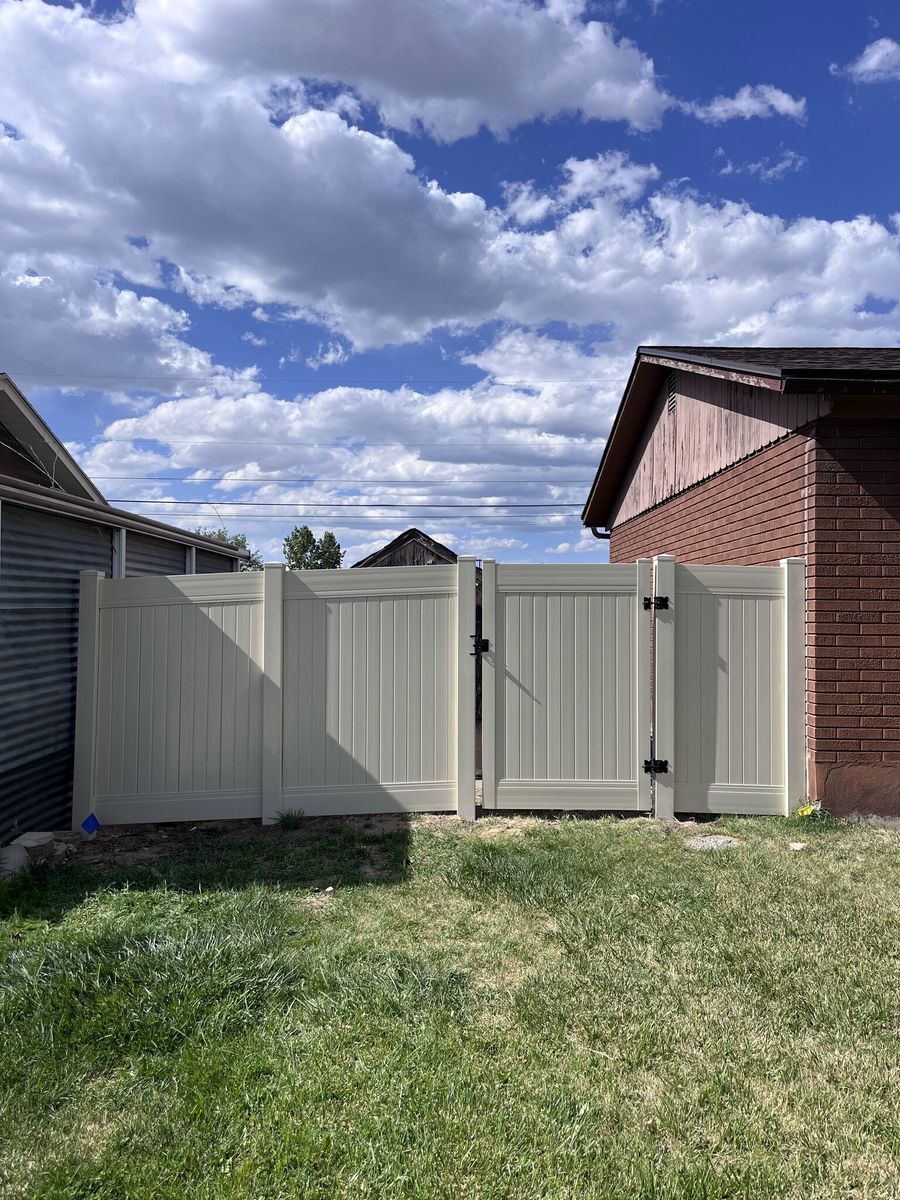
Tan vinyl privacy fence with a matching walk gate between a brick house and a shed in Holladay, UT
Tan vinyl with a matching gate, Holladay.
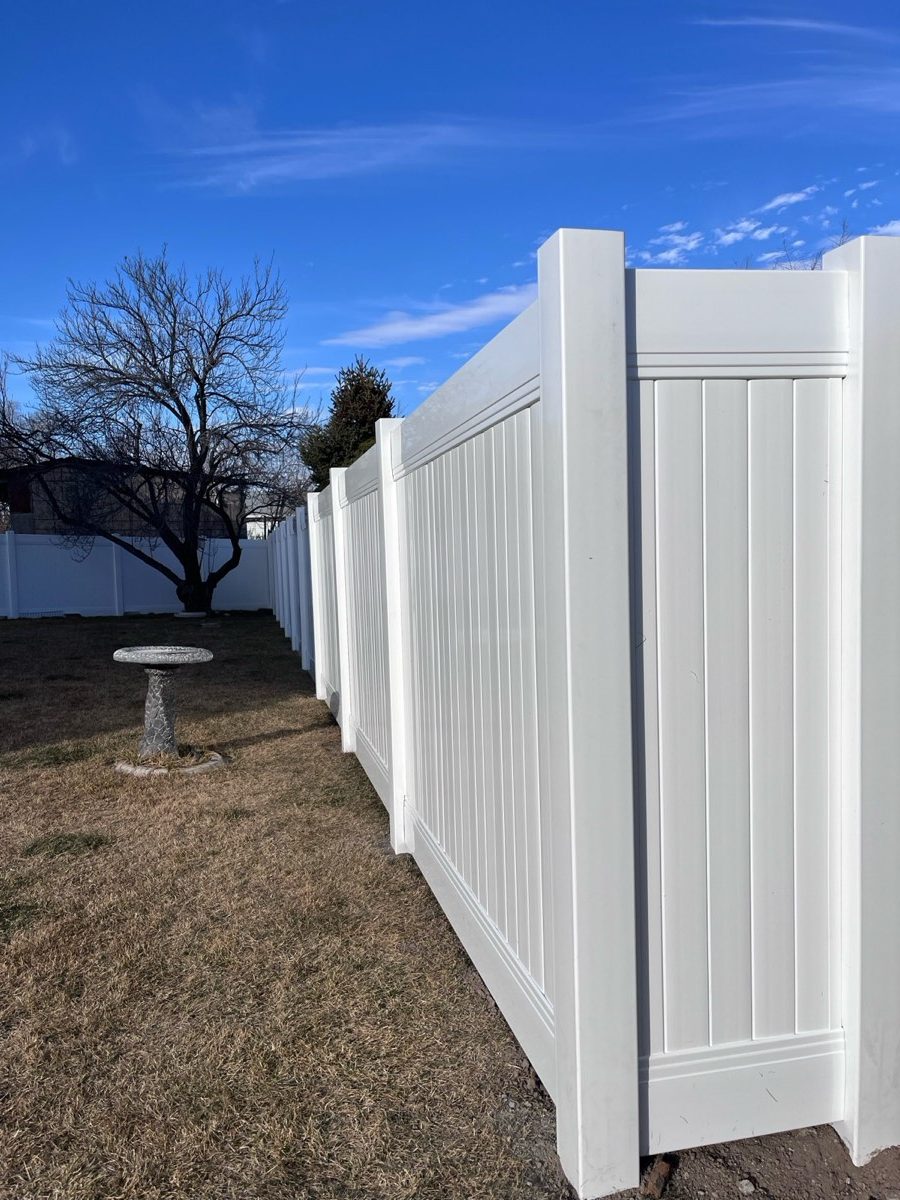
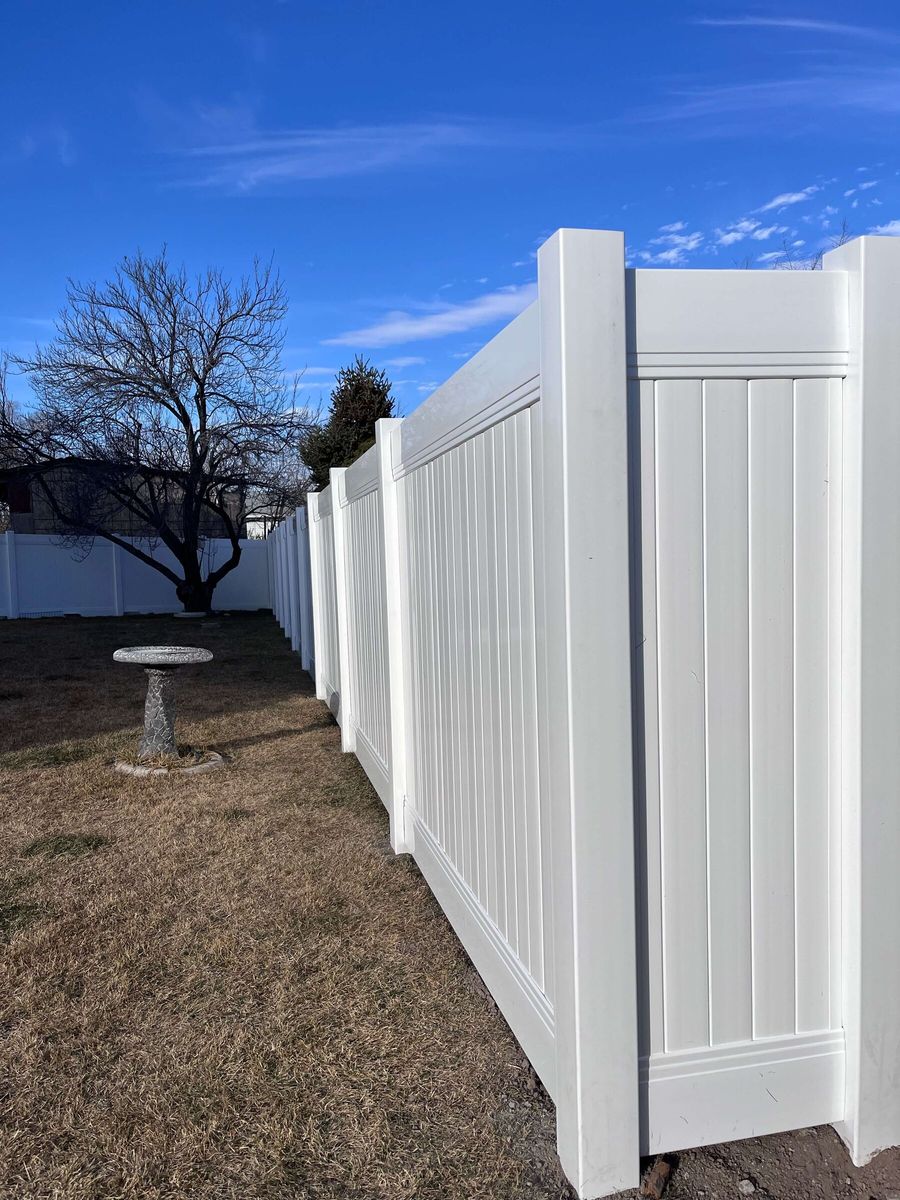
White tongue-and-groove vinyl privacy fence turning a corner in a West Valley City, UT backyard
White tongue-and-groove, no visible fasteners, West Valley City.

Vinyl Fence Installation in Salt Lake City

Vinyl never needs paint, stain, or sealing. It does not rot.

The catch is the sun. Vinyl fades the same way across the Salt Lake Valley. The address does not protect a fence, the product does.

The best vinyl fence for this climate has real UV protection built in. Bargain panels chalk, yellow, and turn brittle.

Trusted Fence Company is a five-star rated vinyl fence company serving Salt Lake County. We install in Salt Lake City, Sandy, South Jordan, Herriman, Murray, and across the rest of the county.

How We Set Vinyl Fence Posts

Short answer: We almost always core drill and dig each hole and set the post in a concrete footing two feet deep, with gate posts set deeper. Retaining walls get a different method, covered below.

Posts are where a vinyl fence is won or lost, and you can't see the work once the job is done. Vinyl rails fit into the posts, so a post that moves shows up fast as a crooked panel, a gap at the bottom, or a gate that won't latch. A wood fence can hide a little drift. Vinyl can't.

Line posts sit 6 to 7 feet apart. Gate posts go deeper than the line because a swinging gate loads its hinge post harder than a straight run ever does, and we reinforce them with an inner steel sleeve. The gates themselves have a welded steel frame hidden inside the vinyl.

Questions to ask any vinyl contractor about posts

  • How deep will the posts go, and why that depth?
  • Are they set in a concrete footing or backfilled with dirt?
  • How will you handle the gate posts?

Our answers: two feet deep in a concrete footing, 6 to 7 feet apart, with gate posts deeper and steel-sleeved. Digging deeper takes more time and more concrete, and a lower price on vinyl sometimes comes from saving on exactly that work. You won't see the difference until a panel sits crooked or a gate latch stops lining up.

Vinyl Fence on a Slope or Retaining Wall

Short answer: On a slope we rack the fence by cutting the slats at an angle, which usually costs only 1 to 3 inches of height, and only on steep slopes. On a retaining wall we grout a steel post into a core drill and sleeve the vinyl post over it.

On a slope

Slopes are where vinyl contractors differ most. We rack the fence: we cut the slats at an angle so it follows your grade, with no triangle gaps underneath. That usually costs only 1 to 3 inches of height, and only on steep slopes. There is no limit on how steep the lot can be.

Stepping the fence down the hill in level sections is the other option. We only suggest it if you like the look, because racking gives the smoother line. Salt Lake City measures fence height from the finished grade of your lot, so if your limit is tight, ask how it will be measured before you pick one.

On a retaining wall

We have a specific way of doing it. We core drill a hole about 2 inches wide and a few inches deep, grout a 1-7/8 inch steel post into it with cement, and sleeve the vinyl post over the top. The post is anchored in the wall instead of surface-mounted, and the fence still finishes like the rest of your line.

● RECENT WORK

Vinyl fences we've built.

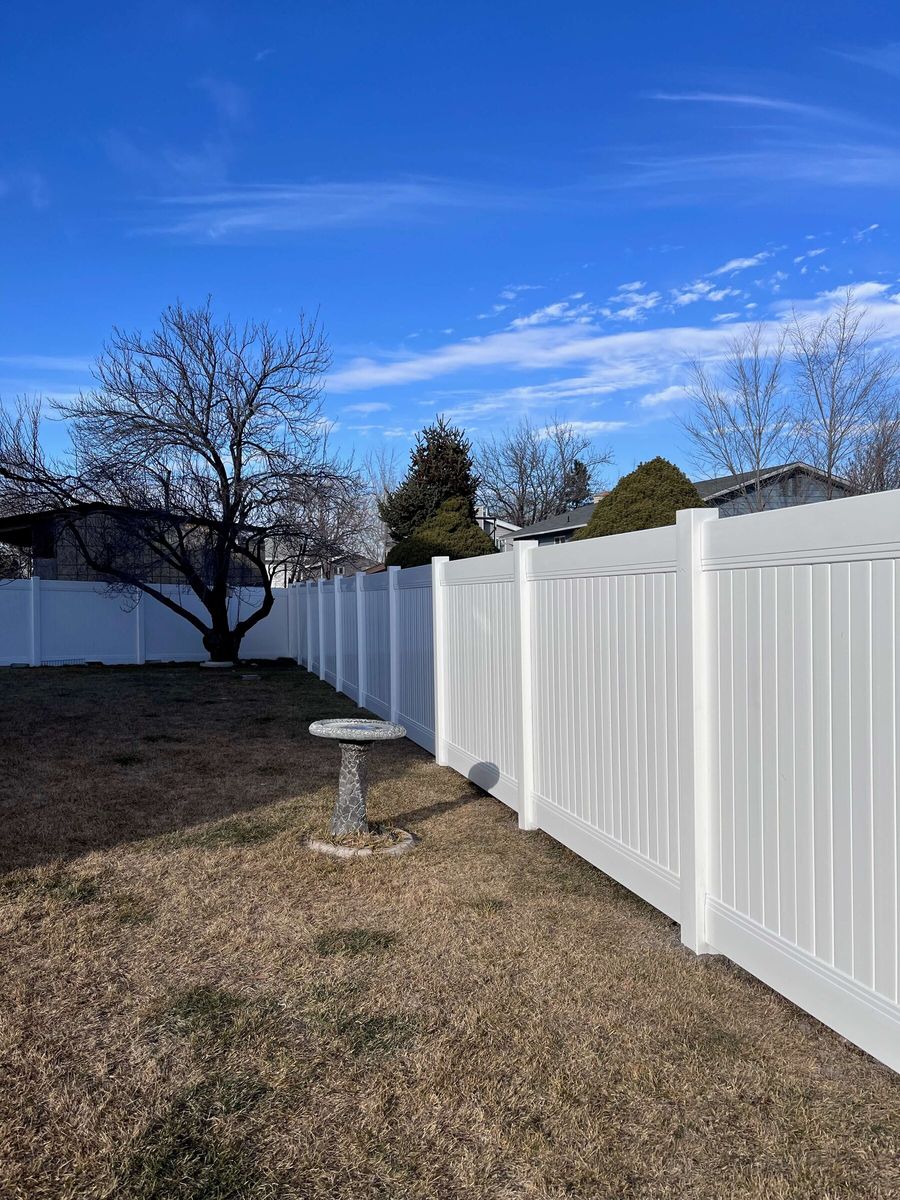
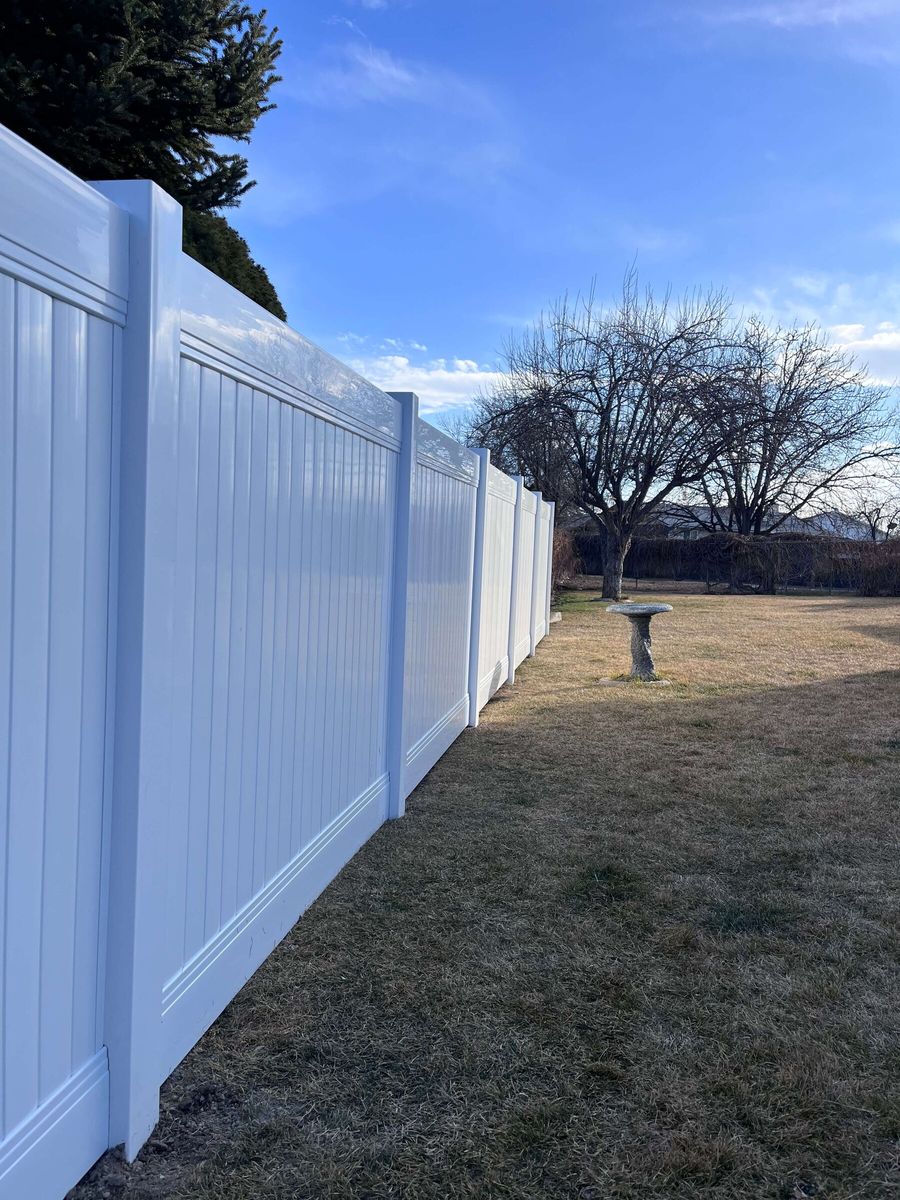
White vinyl privacy fence running along a backyard with a birdbath and bare trees in West Valley City, UT
White vinyl privacy fenceBackyard line · West Valley City, UT
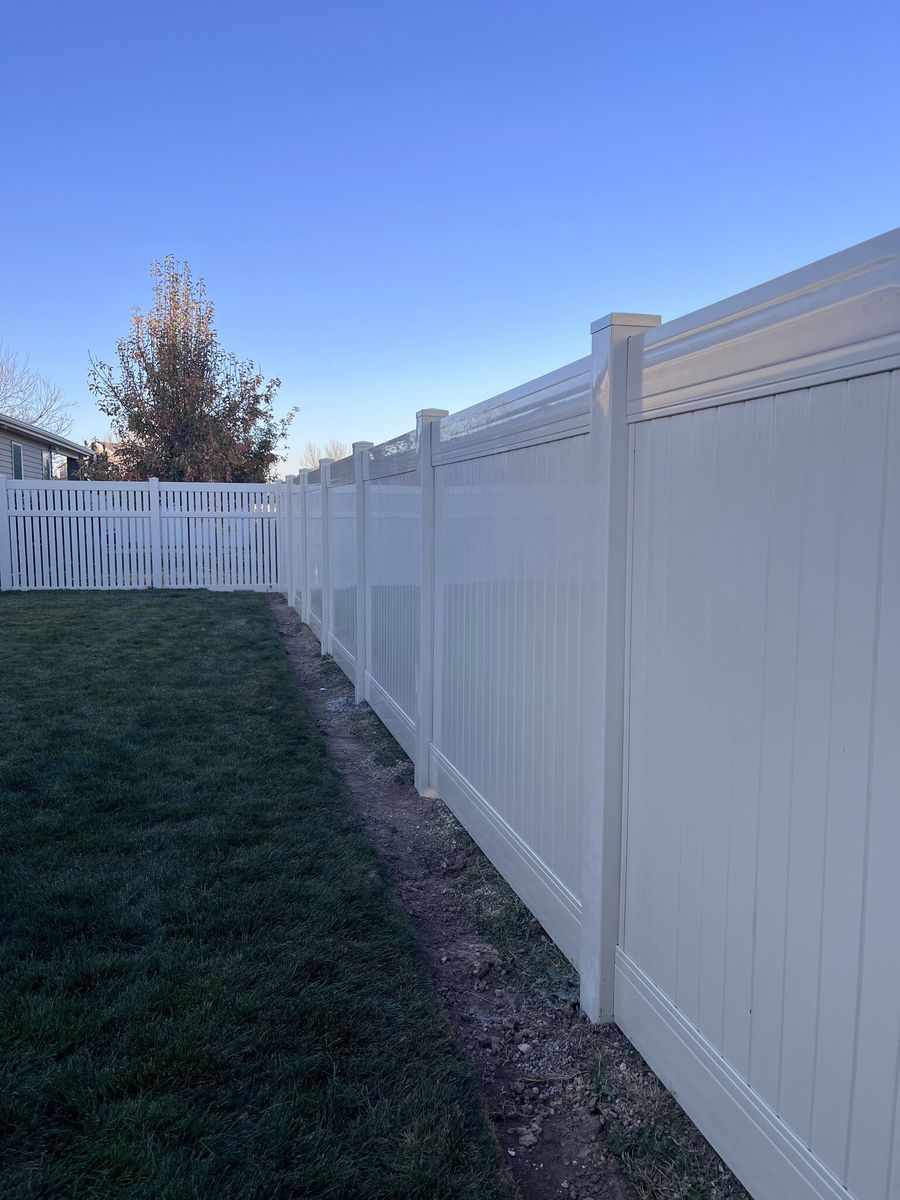
White vinyl privacy fence turning a corner around a backyard with a birdbath in West Valley City, UT
White vinyl privacy fenceCorner run · West Valley City, UT
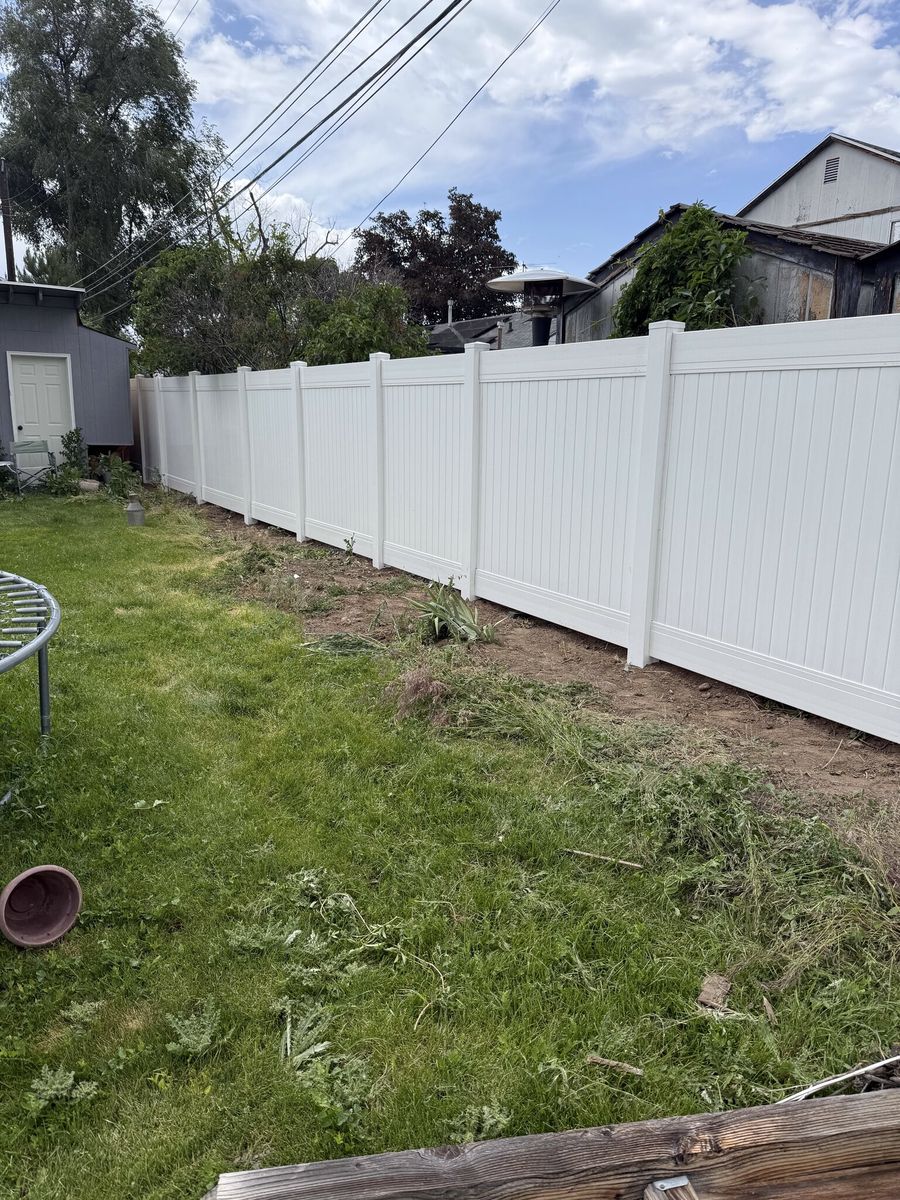
White vinyl privacy fence along a backyard property line in West Valley City, UT
White vinyl privacy fenceBackyard line · West Valley City, UT
Vinyl privacy fence with a capped top running along a lawn in the Salt Lake Valley
Vinyl privacy fenceBackyard line · Salt Lake Valley, UT
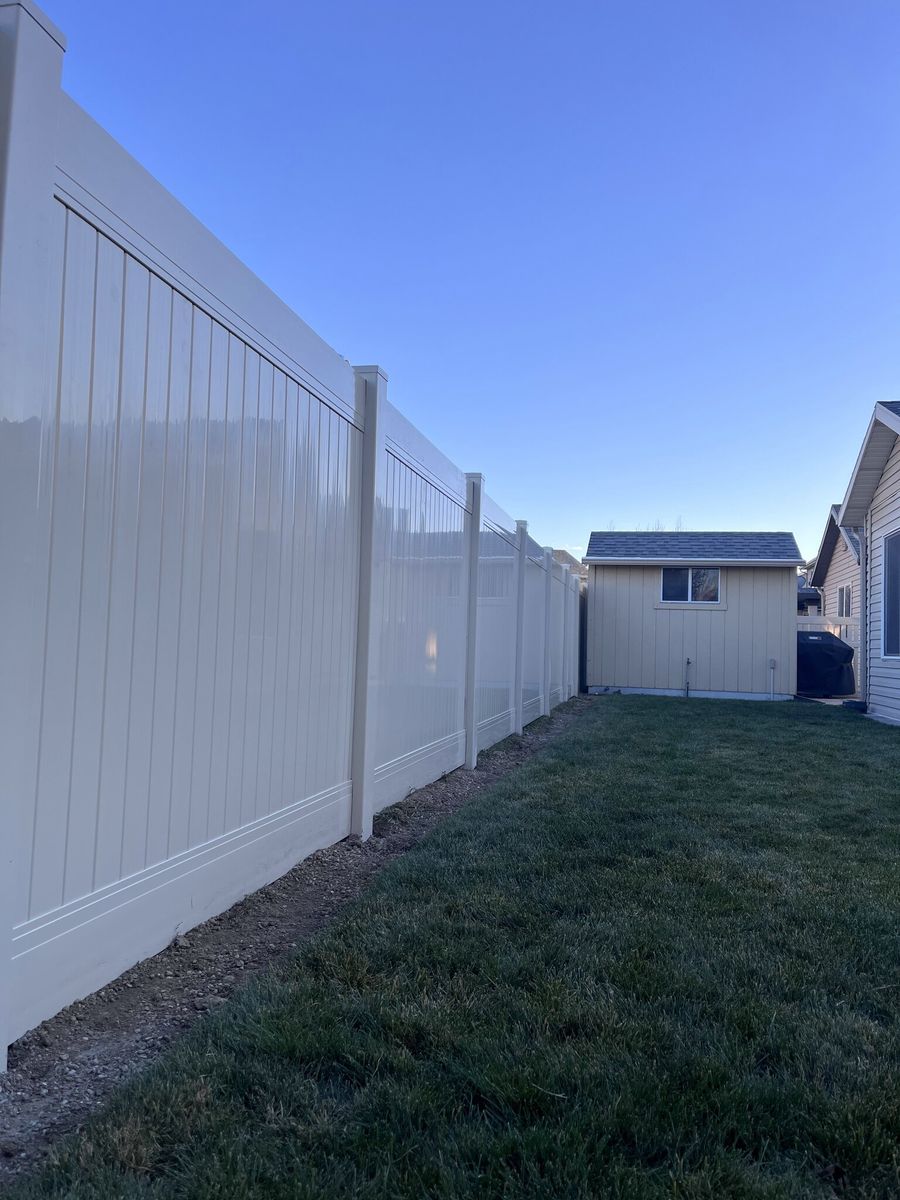
Tall vinyl privacy fence along a backyard with a shed at the end in the Salt Lake Valley
Vinyl privacy fenceBackyard line · Salt Lake Valley, UT
White vinyl privacy fence along a sloped backyard in Murray, UT
White vinyl privacy fenceBackyard line · Murray, UT
Tan vinyl privacy fence and walk gate beside a brick garage in Holladay, UT
Tan vinyl privacy fenceWalk gate · Holladay, UT
Tan vinyl privacy fence and gates beside a driveway in Holladay, UT
Tan vinyl privacy fenceDriveway gates · Holladay, UT

What Happens on Install Day

Short answer: Putting up a vinyl fence takes six stages in a set order, with gates last and a walk-through with you before final payment. Skipping the plumb check on a post is how a vinyl line ends up crooked.

  1. Mark the Line

    We file the Blue Stakes (811) request about a week ahead, so public utility lines are marked before anyone digs. Then the line is laid out against your property stakes or plat, so every post lands in a straight run.

  2. Core Drill and Dig the Posts

    Each hole is core drilled and dug, and the post is set in a concrete footing. Gate posts go deeper than line posts, and a retaining wall gets the steel-post method covered above.

  3. Set Every Post Plumb

    Each post is checked plumb as it goes in and the run is sighted for line before anything is hung, because vinyl rails won't hide a post that leans.

  4. Hang Rails and Panels

    Rails and panels go in between the posts: tongue-and-groove, no gaps, no visible fasteners. Vinyl swells and shrinks with the temperature swing here, so panels are seated to move with it, not forced tight.

  5. Hang the Gates Last

    Walk and drive gates go on once the posts are set. Hinges and latches get adjusted until the gate swings free and closes without dragging.

  6. Walk the Finished Fence

    Together, before final payment. Plumb, level, square, every gate latching, site cleaned up. If anything is off, we make it right before we are paid.

Getting ready for install day

Blue Stakes marks public utility lines. It does not mark private ones such as sprinkler systems, which its own guidance says to have located separately. So before the crew arrives:

  • Flag your sprinkler heads and lines, any buried lighting wire, and a private gas line to a grill or fire pit if you know where it runs
  • Move planters, toys, and patio furniture back from the fence line, and clear a path for materials
  • Keep pets inside while the holes are open
  • If the fence sits on a shared line, give your neighbor a quick heads-up

How to check a finished vinyl fence yourself

  • Sight down each run from one end. The tops should form a clean line, or follow the slope evenly
  • Push on a few posts. They should not move
  • Open and close every gate several times and make sure the latch catches
  • Look for scuffs or cracked caps, and check that dirt and concrete are cleaned up

Height, Permit and HOA Rules Before You Order

Short answer: Salt Lake City requires a building permit for any fence and generally caps fences at 4 feet in front yards and 7 feet at the side and rear. Your HOA can be stricter. Settle height before any panels are ordered.

Two sets of rules apply, and they don't always match. When they disagree, follow the stricter one.

City rules

The city requires a permit from Building Services for a fence. Heights are generally up to 4 feet in a front yard and 7 feet at the side and rear, measured from the finished grade of your lot, and the full rules are in the city's residential fence guidance. Corner lots are tighter: no solid fence taller than 3 feet within 30 feet of a street intersection. In a local historic district you also need a Certificate of Appropriateness, and the city's design guidelines call vinyl inappropriate where it would be visible from the street. Other valley cities set their own limits, so check yours.

HOA rules

An HOA can set height, color, panel style, and which side faces out, and some want written approval before work starts, so ask early. We file the city permit. The HOA application is yours to submit, and we give you whatever documents or materials your HOA asks for. We build to what they allow.

What to have ready for the estimate

  • Your HOA fence guidelines and any approval form
  • Where you think your property line is, plus a plat or survey if you have one
  • Which stretches you want taller for privacy, like a patio or hot tub, and which can stay lower
  • Anything you and your neighbors have talked about for a shared line or which side faces whom

Taller isn't always the fix. A Sandy homeowner wanted an eight-foot fence along her back property line. When Landon walked the yard with her, the fence line wasn't the problem. It was her neighbor's upstairs window looking onto her patio. A shorter privacy section closer to the patio fixed it and stayed within her HOA's rules. We go over height with you at the estimate, before a panel is ordered.

What Drives Vinyl Fence Installation Cost

Short answer: Vinyl fence prices come down to footage, gates, height, style, slope, and what is in the ground. Vinyl usually costs more up front than a basic wood fence, and anyone quoting your yard without seeing it is guessing.

Most bids start with linear feet, then add gates, corners, removal, and extras. Two bids for the same yard can look far apart until you line up what each one includes.

Vinyl Fence Installation Cost in Salt Lake City

We do not quote a price per foot without walking your line. Footage, gates, height, slope, and what is in the ground all move the number. Smaller yards cost more per foot because labor and delivery have a floor.

Your written quote is good for a month, and the price is honored once the deposit is paid.

What changes the price

  • Length and layout. A fence with many corners takes more work than a straight run of the same length
  • Gates. Gate quantity and size are written into your quote, and a double drive gate costs more than a walk gate
  • Height and style. A six-foot solid privacy panel uses more material than a four-foot picket, and semi-private styles price differently again
  • Color. White is our standard. Tan adds about 11% to the material cost, and we can source specialty colors
  • Slope. Racking or stepping takes more measuring and cutting than flat ground
  • What is in the ground. Rock, old tree roots, and buried concrete slow the digging. We account for that when we walk your line, and the price does not go up if something unexpected turns up after you've signed
  • Old fence removal. If your old fence has to come out, taking it down and hauling it away adds $5 per foot plus a $75 landfill fee to your total
  • Access. Carrying materials through a narrow side yard takes longer

Ask every contractor the same questions

  • Is removal and haul-away of my old fence included?
  • How many gates, corners, and end posts are counted?
  • Does the quote name the exact product line?
  • What is left out that could show up later as an extra?

Be careful with a bid that is much lower than the rest. The easiest place to save money on vinyl is underground, where you can't check the work.

What to Expect When You Hire Us as Your Vinyl Fence Contractor

You call or send the form; we answer the same day. We walk your line free, no trip fee, measure, and help you pick style and color against your budget and your HOA's rules. Your written quote spells out gate quantities and sizes and is good for a month, and once you pay the deposit the price is honored. From a signed quote we are almost always out to start about two weeks later, and an average backyard of 150 to 350 feet takes about three days, give or take one. Old fence in the way? Teardown and haul-off adds $5 per foot plus a $75 landfill fee to your total. And because vinyl arrives as finished panels, there's no painting phase, the day we finish is the day it looks done.

Why Homeowners Choose Trusted Fence Company

Vinyl is where cheap corners hide easiest: thin panels, shallow posts, no UV protection. We are a locally owned vinyl fence contractor, and the owner writes every quote.

The insured crew that builds it works to one standard: plumb, level, square. We use Homeland vinyl and give you the warranty paperwork and contact info to activate it.

Want the full picture of what we build? Start with your local fence company serving Salt Lake City.

Frequently Asked Questions

How much does vinyl fence installation cost in Salt Lake City? +

It depends on footage, gates, height, style, slope, and what is in the ground. Tan vinyl adds about 11% to the material cost, and removing an old fence adds $5 per foot plus a $75 landfill fee. We walk your line for free, and the written quote is good for a month.

Is vinyl cheaper than wood? +

Usually not up front. Vinyl typically costs more to install than basic wood. What it saves is the upkeep: no painting, no staining and no rot, so over the years you aren't paying for the same fence twice. If you're deciding between the two, we'll quote both so you can compare the numbers.

What are the downsides of a vinyl fence? +

It costs more up front than basic wood. Cheap panels chalk, yellow and turn brittle in high-altitude sun, which is why we use Homeland vinyl with UV color protection. A hard hit can crack a vinyl panel. And vinyl is more limited in look than wood, which you can stain or paint almost any shade.

What colors does vinyl fence come in? +

Most of our vinyl work is white. Our standard Homeland vinyl also comes in tan and grey, and tan adds about 11% to the material cost. We can source specialty colors too, so ask when we walk your line.

Does vinyl fence turn yellow in the sun? +

Cheap panels do. High-altitude UV is hard on bargain vinyl, so we use Homeland vinyl made with ACCU-Shield UV color protection. Homeland's own warranty says any colored surface gradually fades and chalks in the sun and does not cover that, so ask any contractor which product line they use and what its warranty leaves out.

What does the warranty on a vinyl fence cover? +

Homeland's warranty covers manufacturing defects like peeling, flaking, blistering and rotting, for as long as the original owner owns the home. If a covered defect turns up, Homeland replaces the product or refunds the purchase price, but it does not pay for labor, and it does not cover normal weathering, which includes gradual fading and chalking. You activate it yourself, and we give you the paperwork and the contact info.

Can you install a vinyl fence on a slope or a retaining wall? +

Yes. On a slope we rack the fence to follow your grade by cutting the slats at an angle. That usually costs only 1 to 3 inches of height, and only on steep slopes, with no limit on steepness. Stepping it down the hill is an option if you like the look. On a retaining wall we core drill a hole about 2 inches wide and a few inches deep, grout a steel post into it, and sleeve the vinyl post over the top.

Stop repainting. Start hosing it off.

Call (801) 341‑9099 for a free on-site estimate, same-day response, $0 trip fee, and a written price that stays put.

Call Now