
Composite fencing pros and cons: what are the downsides?
What composite does well, where it falls short, and how it compares with wood and vinyl in Salt Lake City yards.
Composite fencing gives you a woodgrain look with boards that won't rot or peel, and it asks for less upkeep than wood. In the Salt Lake Valley it gets tested by strong high-altitude sun and a long freezing season, and it holds up well. The tradeoffs are real: composite fencing costs more than wood and usually more than vinyl, its shade softens slowly in strong sun, and you choose from the maker's range instead of a stain can. How straight it stays comes down to the posts. Here are the honest pros and cons before you spend the money.
The tradeoffs at a glance
Pros
- Looks like wood, minus the rot. No repainting, and it won't gray out in the sun.
- Minimal maintenance. Systems like Trex Fencing and SimTek need no paint or stain.
- Durable. The planks resist insect damage and shrug off the wet-dry swings that split wood.
- Full privacy. Tongue-and-groove systems like Avimore leave no gaps between slats.
- No finish to redo. It won't peel, so there is nothing to strip and repaint.
- Partly recycled. Trex Fencing planks are 95% recycled wood fiber and plastic.
Cons
- Higher up-front cost than wood, and usually more than vinyl.
- Slow fading. The shade softens in strong sun, and a replacement plank may not match.
- Fewer shades, all set by the maker.
- Expands and contracts with temperature, so it needs room to move.
- Combustible, since it is a wood-and-plastic product.
- Only as straight as its posts.
What composite fencing is made of
"Composite" covers more than one material, and the differences matter for care, shade, and warranty. It is also not the same as a PVC vinyl fence, even though both skip paint: composite blends wood fiber with plastic, while vinyl is PVC through and through. Three composite systems sold in Utah show the range of materials.
Trex Fencing
Boards made of wood fiber and plastic, 95% of it recycled. Trex says its fence needs no sanding, painting, staining, or sealing, and describes cleaning as an occasional wash with soap and water. Some composite boards are also capped with a harder outer shell that helps them stand up to stains and scuffs.
SimTek
Rotationally molded polyethylene panels with internal steel reinforcement. These panels read as stone or wood from the street and carry that steel core for wind.
Avimore
Composite slats that slide into black aluminum posts and rails. The slats come in a woodgrain texture or a smooth matte finish, and they won't rust, rot, or peel.
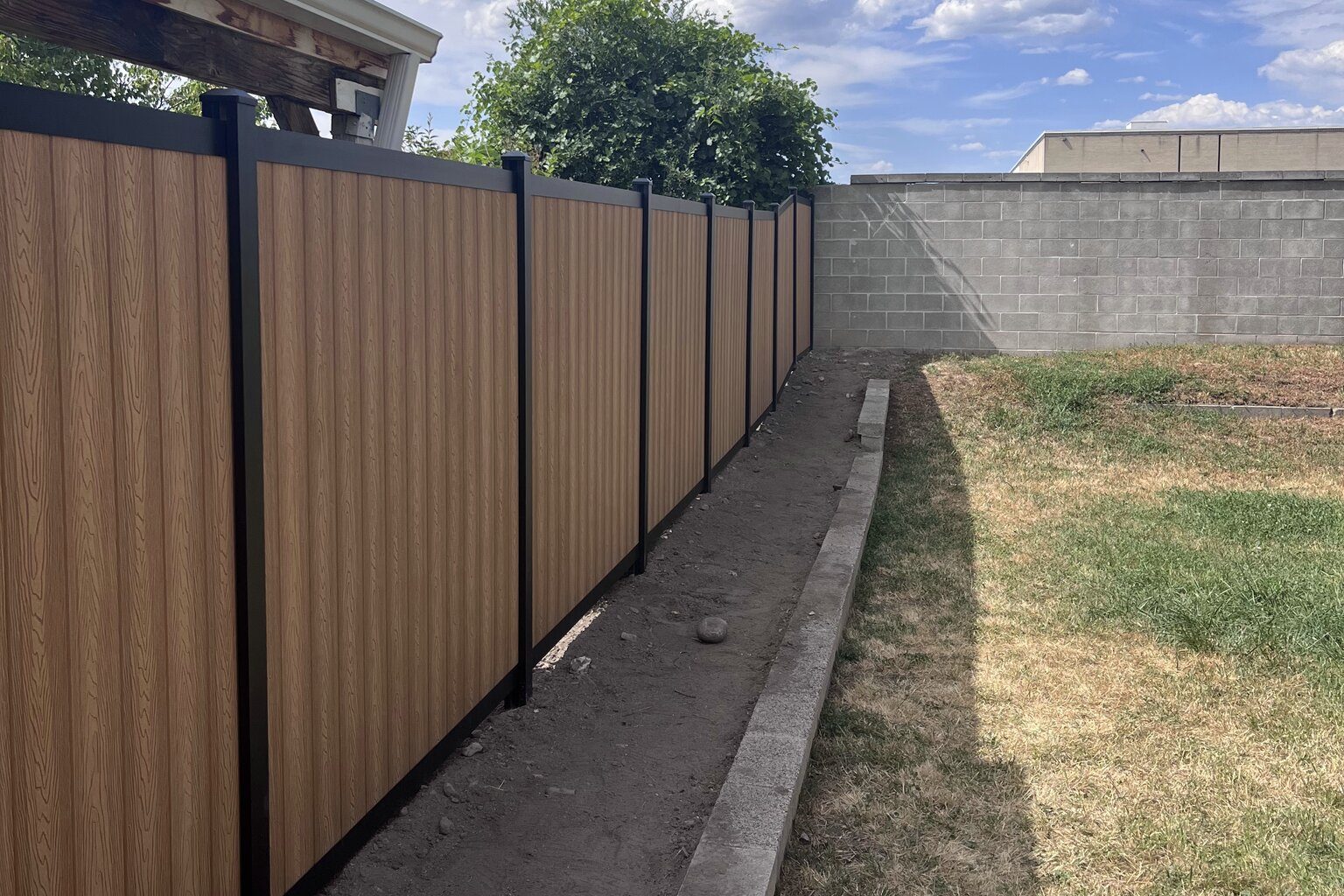
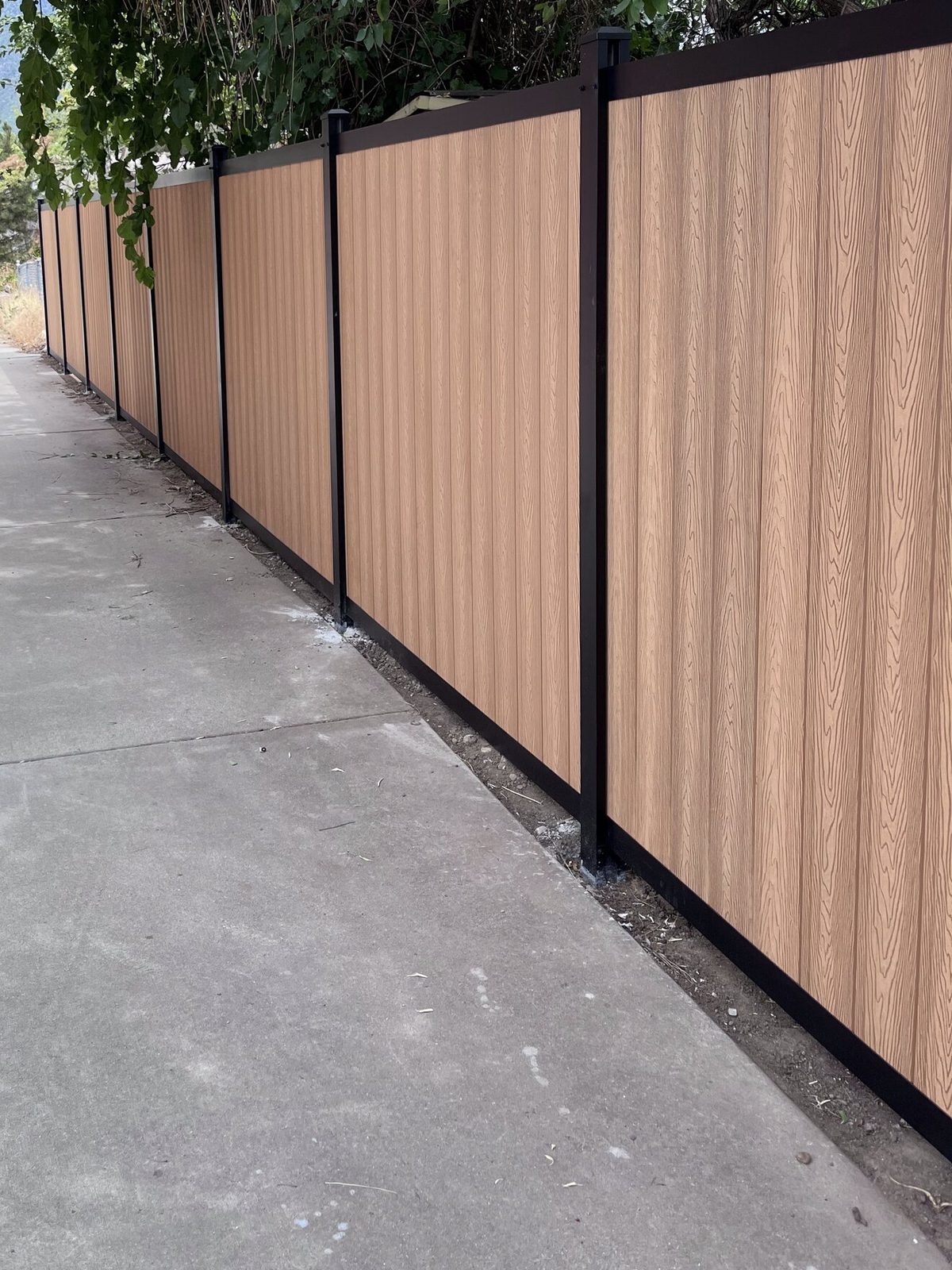
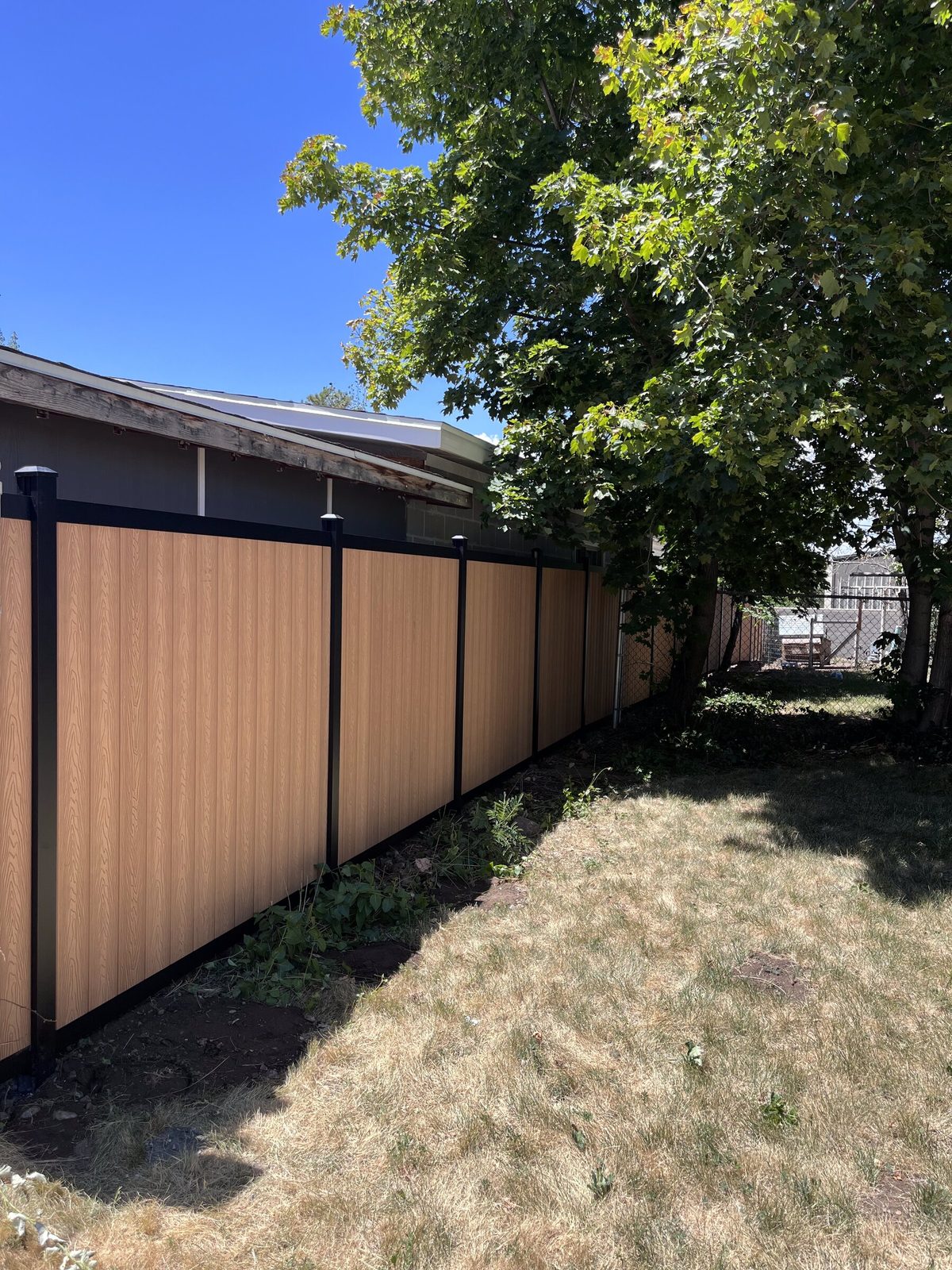
When you compare quotes, ask which system each one uses. Two composite fences can be built from very different materials and carry very different warranties. Our composite jobs across the Salt Lake Valley, from Kearns and South Jordan to Draper and Holladay, all used black aluminum frames with woodgrain slats.
The upsides of composite fencing
Composite fencing's appeal is simple: it looks like wood and asks for less of you. From the sidewalk a woodgrain board reads as wood, which suits older neighborhoods like the brick bungalows of Liberty Wells and the cottages of Sugar House. Unlike wood, it won't rot at the base or gray out in the sun.
Less upkeep than wood
This is the reason most of our customers ask about composite fencing. Trex Fencing and SimTek both skip paint and stain, so you don't need regular staining to keep them looking right. The boards resist insect damage and can withstand harsh weather conditions that wear on wood here, from August sun to January freeze. Less upkeep is not the same as no upkeep, but for a homeowner who is done restaining every few years, the difference is real.
Privacy without gaps
Privacy is solid, too. Tongue-and-groove slats like Avimore's fit together with no gaps between boards, so there is no straight-through sightline through the line. In Salt Lake City, where sun and freeze-thaw both wear on wood, that mix of privacy and low upkeep is what sells composite fencing.
The downsides of composite fencing
The price gap
Cost comes first. Composite fencing has a higher initial cost than wood, and usually more than vinyl. Whether that trade pays off depends on how long you plan to keep the fence, which is worth thinking of as an investment rather than a sticker price. More on that below.
Slow fading in strong sun
Composite softens in tone slowly in strong sun, and runs that face the sun all day show it most. Salt Lake City's airport weather station sits about 4,200 feet above sea level, and UV gets stronger with elevation. Warranties treat this differently. SimTek's, for example, calls some gradual fading normal and covers only abnormal fading. Because the change is gradual, a replacement board may not match its sun-softened neighbors.
A narrower range of shades
Your choice of shade is narrower than wood, too. You pick from the maker's range, not a stain can, and Avimore's composite comes in five. If repainting a fence a new shade every few years matters to you, wood still wins on that one point.
Heat and expansion
Composite expands and contracts as the temperature swings, more than wood does. That is normal for the material, and it is why the boards have to be installed with a little room to move at the ends. Done right, you never notice it. Done in a hurry, with no room left for expansion, boards can bow in a July heat wave.
Fire
Because composite blends wood fiber and plastic, it will burn, the same as a wood fence. That is worth knowing if your yard backs open foothills where fire is a real concern. It is not a reason to rule composite out, just a fact to weigh against a material that will not burn, like aluminum or ornamental iron.
Historic districts
Historic districts add one more limit. In local historic districts like the Avenues and Yalecrest, the city's design guidelines favor see-through fences facing the street. A solid composite privacy fence fits best out of street view there, and a new fence needs a Minor Alteration application first.
Posts still decide the line
Last, a composite fence is only as straight as its posts. Salt Lake City averages about 112 days a year with lows at or below freezing. Freeze-thaw works on posts all winter, and a post set shallow or in tamped dirt is the first to move, which is why our fence installation sets every post in concrete.
Is composite fencing worth the money?
For the right homeowner, composite fencing can be worth the higher price. The math is simple: you pay more up front and less over the years, because there is no stain, sealer, or paint to buy and reapply. If you plan to sell in a year or two, that math rarely pays off, and wood or vinyl is the smarter spend. If you plan to stay, composite starts to look less like a cost and more like money well spent, since the upkeep you skip adds up season after season. We will put wood, vinyl, and composite numbers side by side so you can see the trade in real figures for your property, not a national average.
Warranties differ, so read them
One more thing separates the composite systems: the warranty. SimTek's limited lifetime warranty for a single-family home covers only abnormal fading and asks you to register within 30 days of installation. Trex and Avimore set their own terms. Before you sign, ask us to pull the actual warranty for the composite fencing system in your quote, so you know what is covered and for how long. It is the kind of detail that separates two quotes that look identical on price.
Recycled content and the environment
The environmental impact of composite cuts both ways. On the plus side, boards like Trex Fencing are made largely from recycled wood fiber and plastic, 95% of it in Trex's case, which keeps material out of a landfill. On the other side, that plastic does not break down the way an untreated cedar board eventually will. If reusing recycled materials is what matters to you, composite has a real story. If a fully natural, biodegradable material is the goal, cedar is the honest pick.
Composite fencing vs. wood and vinyl
Each of these materials trades price against upkeep in its own way. Here is how they compare for a Salt Lake City yard.
| Material | Upfront cost | Upkeep | Look and shade |
|---|---|---|---|
| Cedar (wood) | Lowest of the three | Needs stain or sealer; grays if skipped | Natural wood; any stain shade, and you can change it |
| Vinyl | Middle | Low; a rinse with a hose | Solid factory shades, usually white or almond |
| Composite | Highest | Low; no stain or paint on Trex and SimTek | Woodgrain boards in the maker's range; softens slowly in sun |
If a natural wood look matters and you don't mind staining, cedar still makes sense, and we offer fence staining and sealing for that upkeep. If you're done with upkeep, vinyl and composite both fit, and the choice comes down to look and budget. For more on how each material holds up here, read Cedar, vinyl, or composite: what lasts in Utah.
Gates, post caps, and accessories
A composite fence is more than its panels. Matching gates, post caps, and hardware are the accessories that decide how the finished line looks and works, and they are worth speccing at the same time as the fence panels. A composite gate carries more weight than a single panel, so its posts and hinges get sized up. Ask which of these a quote includes, because a low number that leaves out gate hardware is not the number you will pay.
How we install it so it stays straight
Whatever system you choose, the posts decide whether the line stays straight. Our posts go two feet deep in concrete, and gate posts go deeper. During installation we check each post plumb, level every frame, leave the composite panels room to expand, and walk the finished fence with you before final payment.
Ask us to bring composite samples to your estimate, so you can compare shades on your own property. For how the job runs from permit to final walk, see composite fence installation in Salt Lake City. Planning a fence in Salt Lake City? Check the height limits first in How tall can a fence be in Salt Lake City?
Watch
The Pros and Cons, on Video
Loads only when you press play, so it never slows the page down.

Written by
Landon Mickelson
Owner & Estimator, Trusted Fence Company
Landon Mickelson was born and raised in Utah. He got his start in the fencing industry in 2024 before teaming up with his professional building partners to found Trusted Fence in 2026. He brings a personal, thoughtful approach to an industry filled with contractors trying to make a quick buck at your expense.
Frequently Asked Questions
What is composite fencing? +
Fencing built from manufactured boards or panels instead of solid lumber. Many styles carry a woodgrain look, and the boards won't rot. What the boards are made of varies by system.
How much does a composite fence cost? +
It depends on footage, height, gates, and the system you choose. Composite costs more up front than wood, and usually more than vinyl. We price it in writing at a free on-site estimate.
What is composite fencing made of? +
It depends on the system. Trex Fencing is wood fiber and plastic, 95% of it recycled. SimTek is rotationally molded polyethylene with internal steel reinforcement. Avimore sets composite slats in black aluminum posts and rails.
What are the downsides of composite fencing? +
It costs more up front than wood, and usually more than vinyl. Its shade softens slowly in strong sun, and shades are limited to the maker's range. It also stays straight only as long as its posts do.
What are some common problems with composite fencing? +
Shade softens slowly on runs that face the sun all day. A replacement board may not match boards the sun has already softened. Leaning starts at the posts: a post set shallow or in tamped dirt is the first to move.
Is composite or vinyl fencing better? +
Both avoid rot and painting, so it comes down to look and budget. Composite gives you a woodgrain look. Vinyl usually costs less. Seeing samples of each in your own yard makes the choice easier.
Straight lines. Straight answers.
Free on-site estimate, a written price that does not move, and a same-day response when you call. Anywhere in Salt Lake County.