
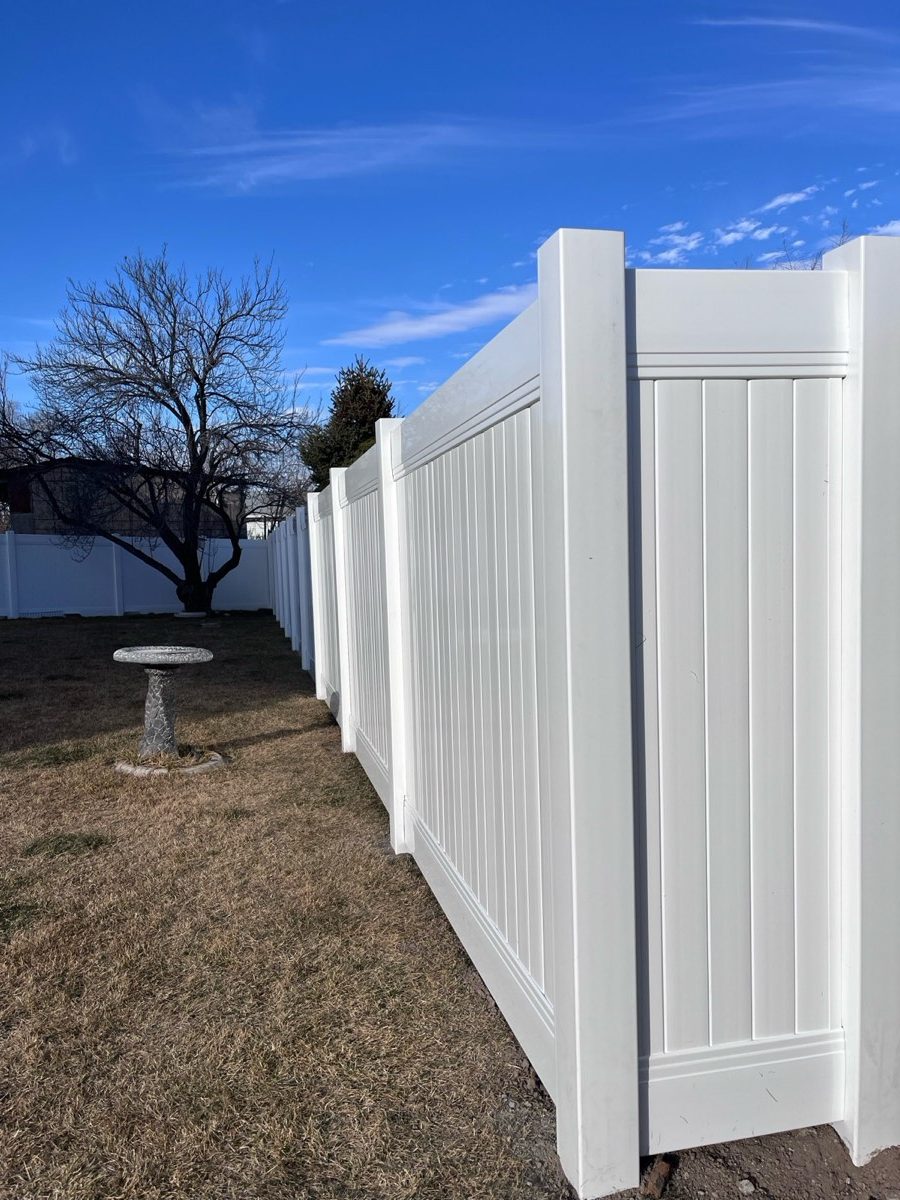
Best fence material for high winds in Salt Lake City
Open fences give wind the least to push on, but any fence depends on its posts.
What Utah's downslope winds have done, and how I set posts and gates for wind.Open fences like aluminum, ornamental iron and chain link give wind the least to push on, so they are the easiest to keep standing. Solid vinyl, wood and composite fences can work in wind too, but they catch much more of it, so the posts have to do more of the work.
On this page
- Which Fence Materials Handle High Wind Best
- What Utah's Downslope Winds Do to a Fence
- How I Set Posts and Gates for Wind
- Choosing a Wind-Resistant Fence for Your Yard
Which Fence Materials Handle High Wind Best
A gust pushes on the panels, the panels pass that load to the posts, and the posts carry it into the ground. The more solid the fence, the more load there is, so the first question on a windy lot is how much privacy you need. I build fences at Trusted Fence Company, a fence contractor in Salt Lake City, and this is how the common types compare.
- Aluminum and ornamental iron: open pickets, so wind passes between them. A good fit if you want to keep your view and don't need privacy.
- Chain link: mostly open mesh. Privacy slats or a windscreen change that, because they close up the mesh. The ASTM standard for chain link tennis court fence recommends a sturdier framework, closer post spacing or back bracing when windscreens will be installed.
- Shadow box: boards alternate on both sides of the rails, so the fence looks finished from both yards and some air passes between the boards.
- Vinyl and composite: solid privacy panels that depend on how the posts are set.
- Wood: solid privacy panels as well. On wood posts, decay is worst at the ground line, according to the U.S. Forest Products Laboratory, and a weakened post has less to hold the fence in a gust.
Height adds to it, because a taller solid fence is a bigger surface for wind. In Salt Lake City, a fence in front of the front building line is capped at 4 feet, and a fence at or behind the primary facade is capped at 7 feet. Fences over 6 feet need construction plans with reinforcement and foundation details, and every fence needs a building permit (Salt Lake City code 21A.40.120).
What Utah's Downslope Winds Do to a Fence
The wind that matters most for fences along the Wasatch Front is the downslope wind. Utah's Enhanced State Hazard Mitigation Plan, from the Utah Division of Emergency Management, describes downslope winds as winds generated when a deep layer of air is forced over a barrier. The air speeds up as it comes down the mountain and forms a wave at the base of the terrain, and the strongest winds are expected in that wave region.
The same plan records what that can do. In December 2011, a downslope windstorm gusted to 102 mph in Centerville, with the heaviest damage between North Salt Lake and South Ogden.
The Salt Lake Valley gets hit too. On September 8, 2020, winds in the Salt Lake and Tooele Valleys reached 88.6 mph. Over 180,000 homes and businesses lost power along the Wasatch Front, Salt Lake City schools closed for three days, and the Capitol Complex closed because of tree damage. In April 2018, gusts in the valley blew down trees, one onto a house in Murray, and sent trampolines into yards and over fences.
Most days are nowhere near that, but a fence has to stand up to the worst gust it will see, not the average afternoon. Because the strongest winds tend to land at the base of the mountains, yards on the east bench and in the foothills are the ones to plan most carefully for wind.
How I Set Posts and Gates for Wind
Whatever the material, the posts are what keep a fence up. My crew sets posts two feet deep in concrete, and gate posts and 8-foot fences go deeper. On vinyl, we almost always core drill and dig to set the post in a concrete footing, and the posts sit 6 to 7 feet apart.
A gate is the other weak point: it hangs off a single post, and a wide gate catches a lot of wind. Our vinyl gate posts are reinforced with an inner steel sleeve, and the gates have a welded inner frame hidden in the vinyl, so the gate keeps its shape in a gust.
I walk the line and write every quote myself, so tell me if your lot gets hit hard by wind. If you already have a fence and are not sure it will hold, we offer fence inspection. To see the other fences we build, start from the Trusted Fence Company home page.
Choosing a Wind-Resistant Fence for Your Yard
- You want to keep the view: aluminum or ornamental iron.
- You want privacy and some relief from wind: shadow box.
- You need full privacy: vinyl, wood or composite, with posts set deep and a city plan if you go over 6 feet.
- You want something simple that usually costs less: chain link. Think twice before adding slats or a windscreen, because they close up the mesh.
Whichever you choose, ask your installer how deep the posts go and what they are set in.
Call Trusted Fence Company for a same-day response and a free estimate, or ask me which fence fits your yard's wind exposure.
Watch
Watch: best fence material for high winds

Written by
Landon Mickelson
Owner & Estimator, Trusted Fence Company
Landon Mickelson was born and raised in Utah. He got his start in the fencing industry in 2024 before teaming up with his professional building partners to found Trusted Fence Company in 2025. He brings a personal, thoughtful approach to an industry filled with contractors trying to make a quick buck at your expense.
Frequently Asked Questions
What type of fence is best for a windy area? +
Open styles like aluminum, ornamental iron and chain link, because wind passes through them. If you need privacy, shadow box leaves room for air between the boards, and a solid vinyl, wood or composite fence can work with deep posts. Along the Wasatch Front, downslope winds hit hardest near the base of the mountains, so your lot matters as much as the material.
Do you need gaps in a fence for wind? +
No. Gaps lower the load on a fence, but a solid fence can be built to carry that load in its posts instead, set two feet deep in concrete.
How do you reinforce a fence for high winds? +
On a new fence, the reinforcement is in the posts and gates. Posts go two feet deep in concrete, and gate posts and 8-foot fences go deeper. On vinyl, posts sit 6 to 7 feet apart, gate posts get an inner steel sleeve, and the gates have a welded inner frame hidden in the vinyl. If you already have a fence and are not sure it will hold, we offer fence inspection.
How much wind can a fence withstand? +
There is no honest single number. It depends on how solid the fence is, how tall it is and how its posts are set. For scale, the Utah Enhanced State Hazard Mitigation Plan records winds of 88.6 mph in the Salt Lake and Tooele Valleys on September 8, 2020, and gusts of 102 mph in Centerville in December 2011. In Salt Lake City, a fence over 6 feet needs construction plans showing reinforcement and foundation details.
What is the strongest privacy fence? +
A privacy fence is only as strong as its footings. For privacy with less wind load, shadow box leaves gaps between boards. A fully solid vinyl, wood or composite fence asks more of its footings.
Straight lines. Straight answers.
Free on-site estimate, a written price that does not move, and a same-day response when you call. Anywhere in Salt Lake County.